Introduction
Telecommunications and data management are the backbone of modern digital societies. The rapid advancements in these fields have revolutionized the way we communicate, access information, and manage data. This article explores the latest developments in telecommunications and data management, highlighting the technologies driving these changes and their implications for businesses and consumers.
Telecommunications Developments
5G Networks
The deployment of 5G networks is one of the most significant advancements in telecommunications. Offering speeds up to 100 times faster than 4G, 5G technology enables real-time data transfer, supports massive IoT (Internet of Things) deployments, and provides low-latency communication critical for applications like autonomous vehicles and remote surgery. Key features include:
Enhanced Mobile Broadband (eMBB): Improved speeds and capacity for mobile internet users.
Ultra-Reliable Low Latency Communications (URLLC): Essential for mission-critical applications.
Massive Machine-Type Communications (mMTC): Supports a vast number of connected devices.
Internet of Things (IoT)
IoT technology continues to expand, connecting billions of devices and enabling smart homes, cities, and industries. The growth of IoT is driven by advancements in sensor technology, connectivity, and data analytics. Key developments include:
Edge Computing: Processing data closer to where it is generated, reducing latency and bandwidth use.
AI Integration: Utilizing artificial intelligence to analyze data from IoT devices for predictive maintenance, automation, and enhanced decision-making.
Security Enhancements: Addressing the challenges of securing vast networks of connected devices.
Satellite Internet
New satellite internet technologies, such as SpaceX’s Starlink and OneWeb, are transforming global connectivity by providing high-speed internet access to remote and underserved areas. These low Earth orbit (LEO) satellite constellations offer lower latency and higher speeds compared to traditional geostationary satellites.
Fiber Optic Expansion
Fiber optic technology continues to expand, offering ultra-fast internet speeds and higher bandwidth. The deployment of fiber-to-the-home (FTTH) and fiber-to-the-premises (FTTP) networks is increasing, driven by the demand for high-speed internet for streaming, gaming, and remote work.
Data Management Developments
Big Data and Analytics
The volume of data generated globally is growing exponentially. Big data technologies and analytics are crucial for managing and extracting value from this data. Key trends include:
Advanced Analytics: Utilizing machine learning and AI to analyze large datasets for insights, predictions, and decision-making.
Real-Time Data Processing: Enabling businesses to act on data as it is generated, improving responsiveness and operational efficiency.
Data Visualization: Tools and techniques for presenting complex data in intuitive, visual formats.
Cloud Computing
Cloud computing continues to revolutionize data management by providing scalable, on-demand resources and services. Key developments include:
Hybrid and Multi-Cloud Strategies: Businesses are adopting hybrid and multi-cloud approaches to leverage the benefits of different cloud providers and improve resilience.
Serverless Computing: Allowing developers to run applications without managing servers, reducing operational complexity.
Security and Compliance: Enhancing cloud security measures and ensuring compliance with data protection regulations.
Data Privacy and Security
With the increasing amount of data being collected, data privacy and security have become paramount. Developments in this area include:
Regulatory Compliance: Adhering to regulations like GDPR, CCPA, and others to protect user data and privacy.
Encryption and Data Masking: Implementing advanced encryption methods and data masking techniques to secure sensitive information.
Identity and Access Management (IAM): Strengthening authentication and authorization processes to protect data from unauthorized access.
Blockchain Technology
Blockchain technology offers a new approach to data management by providing decentralized, secure, and transparent systems. Key applications include:
Cryptocurrencies: Managing digital assets and transactions securely.
Supply Chain Management: Enhancing transparency and traceability in supply chains.
Smart Contracts: Automating and securing contractual agreements without intermediaries.
Implications and Future Outlook
The developments in telecommunications and data management are reshaping industries and societies. Businesses are leveraging these technologies to improve efficiency, innovate, and create new value propositions. Consumers are experiencing faster, more reliable communication and access to services. However, challenges remain, including the need for robust security measures, regulatory compliance, and addressing the digital divide.
The future will likely see further integration of AI, IoT, and advanced analytics into telecommunications and data management systems. The ongoing expansion of 5G networks, advancements in satellite internet, and innovations in data privacy and security will continue to drive progress in these fields. Embracing these technologies responsibly and ethically will be crucial to maximizing their benefits and mitigating risks.
Conclusion
Telecommunications and data management are at the forefront of technological innovation, driving significant changes in how we live and work. The developments in 5G, IoT, satellite internet, and fiber optics, along with advancements in big data analytics, cloud computing, and blockchain, are transforming industries and creating new opportunities. As we move forward, addressing the challenges of security, privacy, and accessibility will be essential to harnessing the full potential of these technologies.
Essay Writing Service Features
Our Experience
No matter how complex your assignment is, we can find the right professional for your specific task. Academiarank is an essay writing company that hires only the smartest minds to help you with your projects. Our expertise allows us to provide students with high-quality academic writing, editing & proofreading services.
Free Features
Free revision policy
$10Free bibliography & reference
$8Free title page
$8Free formatting
$8How Our Essay Writing Service Works
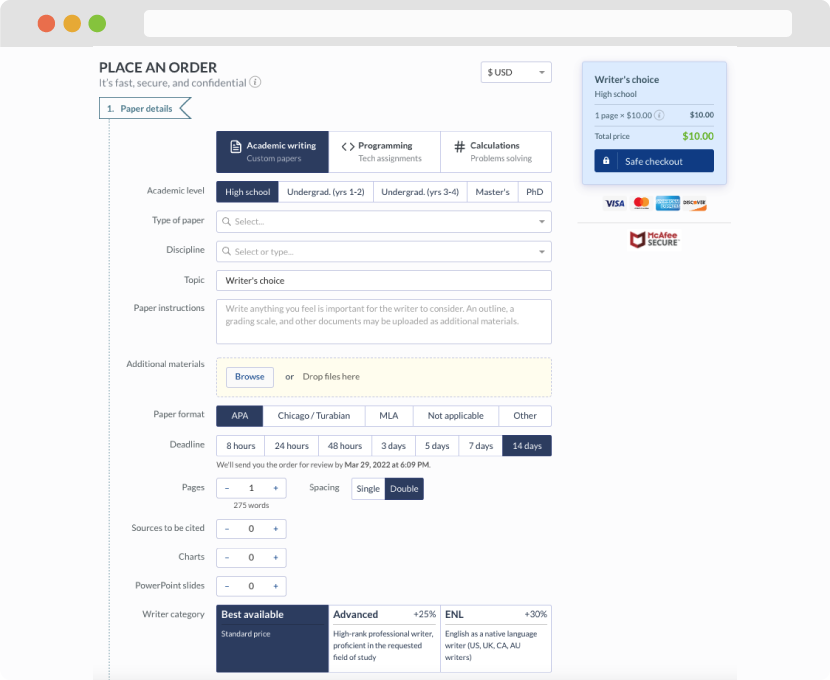
First, you will need to complete an order form. It's not difficult but, in case there is anything you find not to be clear, you may always call us so that we can guide you through it. On the order form, you will need to include some basic information concerning your order: subject, topic, number of pages, etc. We also encourage our clients to upload any relevant information or sources that will help.
Complete the order form
Once we have all the information and instructions that we need, we select the most suitable writer for your assignment. While everything seems to be clear, the writer, who has complete knowledge of the subject, may need clarification from you. It is at that point that you would receive a call or email from us.
Writer’s assignment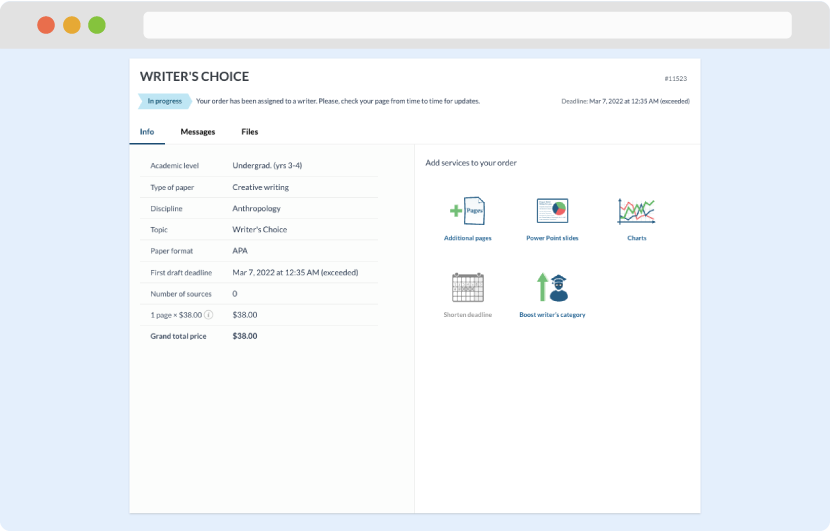
As soon as the writer has finished, it will be delivered both to the website and to your email address so that you will not miss it. If your deadline is close at hand, we will place a call to you to make sure that you receive the paper on time.
Completing the order and download